
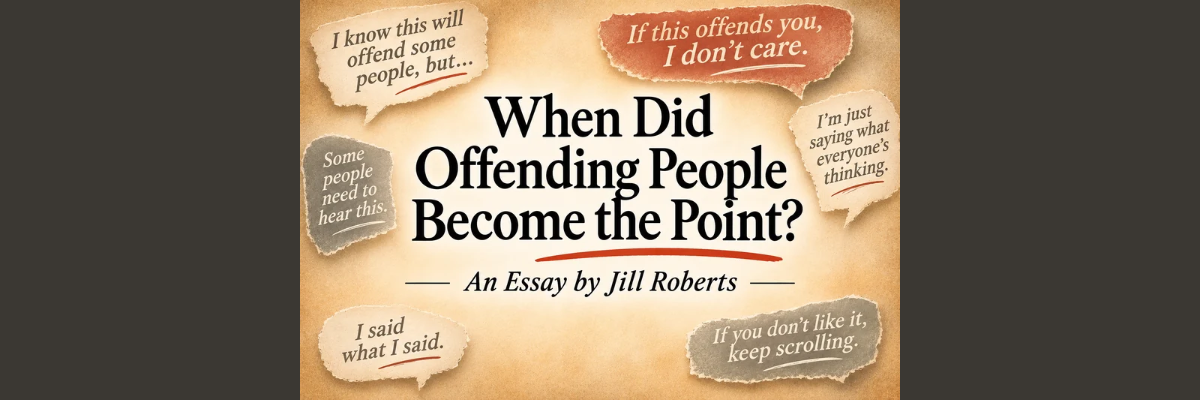
When Did Offending People Become the Point?
An Essay by Jill Roberts
Over the last several years, I’ve noticed a growing trend in opinion posts on social media. They often begin with some version of, “If this offends some people, I don’t care.”
Somewhere along the way, it seems we’ve confused being outspoken with being abrasive. I’m certainly not suggesting that we avoid difficult conversations or silence ourselves for fear of offending someone. But I do wonder when being deliberately provocative became something to take pride in.
That doesn’t mean we shouldn’t challenge misinformation, injustice, or ideas we believe are harmful. But when we begin a statement by anticipating that it will offend someone, perhaps we should stop for a moment and ask ourselves what we’re hoping to accomplish by saying it.
Do we want to make a point or make a difference? Or are we simply looking to provoke a reaction, validate our own beliefs, or demonstrate that we don’t care what anyone else thinks?
If our true intention is to encourage understanding and influence thinking then the way we deliver our message matters enormously. Because getting someone to consider a different perspective rarely begins with them bracing for insult.
Think about how you respond when someone approaches you with hostility. Even if there’s some truth in what they’re saying, our natural inclination is to become defensive. We stop listening. Now imagine that same person approaching you with sincerity, an open mind, and respect for your perspective? Wouldn’t you be more inclined to listen to their opinion and engage in a productive way?
Perhaps that’s what troubles me most about the direction our country has taken. We seem to have developed a bullying mentality when it comes to expressing differing opinions, and that hostility only serves to deepen the divisions within our society.
Maybe the next time we’re tempted to begin with “I know this will offend some people, but…” we could pause long enough to consider whether there’s another way to deliver our opinion—not because we’re afraid of offending someone—but because we actually want others to consider a different perspective and potentially open the door to meaningful conversation.